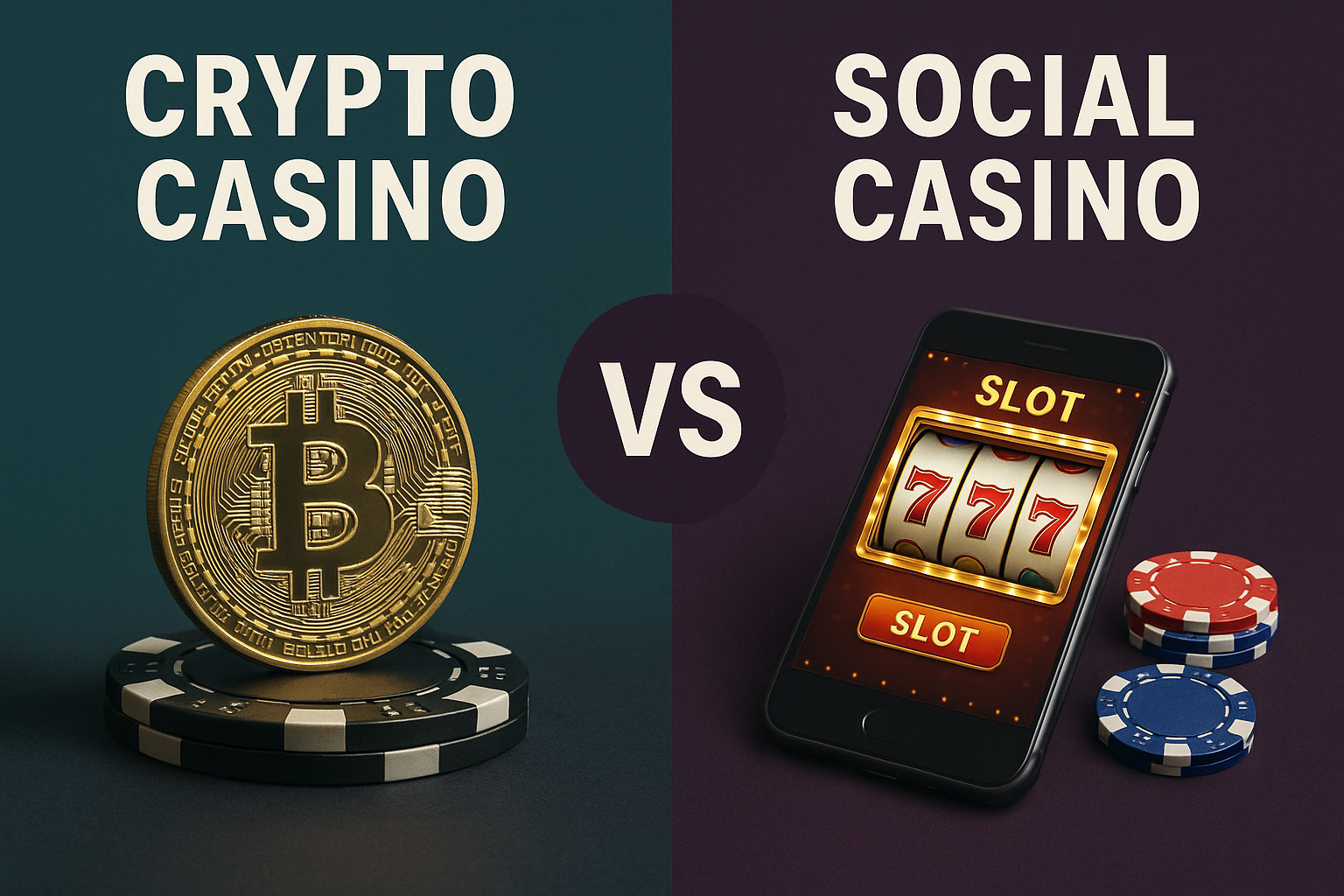
Online gaming no longer means one thing. Over the past few years, casino-style entertainment has split into two very different lanes: crypto casinos, built around cryptocurrency and blockchain technology, and social casinos, built around free-to-play entertainment and virtual currency. At a glance they can look almost identical — the same slot reels, the same card tables, the same flashing jackpots. Underneath, they work in fundamentally different ways.
Those differences matter. They shape how money moves (or doesn’t), whether the platform is legal where you live, what you can actually win, how your identity and funds are protected, and how much financial risk you take on. Choosing without understanding those distinctions is how people end up on the wrong platform for their goals.
This guide breaks down both models in plain language — definitions, a side-by-side comparison, payments, safety, legality, and responsible-play considerations — so you can decide which experience genuinely fits you. It’s written to inform, not to push you in one direction.
Key takeaway: A crypto casino is real-money gambling settled in cryptocurrency, usually run by offshore operators. A social casino is entertainment-first gaming played with virtual coins that have no cash value, though some use a “sweepstakes” model to award prizes. The right choice depends on your goals, your risk tolerance, and the laws in your state.
What Is a Crypto Casino?
A crypto casino is an online gambling site where you deposit, wager, and withdraw using cryptocurrency instead of traditional money. Common currencies include Bitcoin (BTC), Ethereum (ETH), Litecoin (LTC), and stablecoins such as USDT or USDC, which are pegged to the US dollar to reduce price swings.
Here’s how the core loop typically works:
• You fund a crypto wallet. A wallet is software (or hardware) that holds your digital coins and lets you send and receive them. The casino gives you a deposit address; you send coins to it.
• You wager in crypto. Bets are placed and settled in the cryptocurrency you deposited, or in a site-specific token that tracks its value.
• You withdraw to your wallet. Winnings are sent back to your wallet address, often faster than a traditional bank transfer because transactions settle on a blockchain rather than through a bank.
Two features define the category. The first is blockchain settlement — transactions are recorded on a public, tamper-resistant ledger, which can make payments fast and traceable. The second is provably fair gaming, a system where the math behind each game round can be independently verified using cryptography, so a player can check that a result wasn’t manipulated after the fact.
The catch: volatility and licensing
Crypto casinos come with two important realities that traditional gambling doesn’t.
Volatility. If you deposit in Bitcoin or Ethereum, the value of your balance can rise or fall with the market even while it sits untouched. A win can shrink before you cash out; a small stake can grow. Stablecoins reduce this, but they don’t eliminate platform or counterparty risk.
Licensing. Most crypto-first casinos are licensed offshore, historically through jurisdictions like Curaçao, and playing on an offshore site does not bypass your local laws. These platforms operate completely outside local oversight, offering no state-backed consumer safety nets. If a dispute arises over a withdrawal or a closed account, there is often no domestic regulator to appeal to.
This describes the category in general rather than any one operator. For players who specifically want crypto-based play, SpinSaga offers a crypto casino experience alongside its social casino — always review the platform’s own terms and confirm the rules where you live before playing.
What Is a Social Casino?
A social casino is an entertainment-first platform where you play casino-style games — slots, poker, blackjack, roulette-style games — using virtual currency that has no inherent cash value. The goal is the fun of the gameplay, the progression, and the social features, not converting your paycheck into a wager.
Most social casinos use one or two virtual currencies:
• Gold Coins (GC): the standard, just-for-fun currency. You get them free (daily bonuses, level-ups, promotions) or buy coin packs for entertainment. Gold Coins cannot be redeemed for cash. When you’re out, you wait for a top-up or grab more.
• Sweeps Coins (SC): used by platforms that run a sweepstakes model. In this model, Sweeps Coins are typically received free — bundled as a bonus with Gold Coin purchases, given via daily logins, or available through a no-purchase “alternative method of entry” (AMOE), such as mailing in a request. Where the model is permitted, Sweeps Coins can be played and then potentially redeemed for prizes or cash once eligibility rules are met.
The legal engine behind the sweepstakes model is exactly that “no purchase necessary” principle. The Alternative Method of Entry is the free, no-purchase-necessary path operators must offer for obtaining Sweeps Coins, which is what separates a promotional sweepstakes from traditional gambling in most US states.
Social casinos lean heavily on casual, social gameplay: leaderboards, gifting, tournaments, daily rewards, and community events. There’s no direct cash wagering — you’re never staking dollars on a spin the way you would at a real-money casino.
SpinSaga is one example of a social casino experience in this space, using the Gold Coin / Sweeps Coin structure and offering a welcome bonus for new players (currently advertised as 20 SC + 200,000 GC). SpinSaga runs both a social casino and a separate crypto casino, so players can choose the style that fits them. As with any platform, its offers, availability, and terms can change, so treat the operator’s own site and terms as the source of truth.
Key takeaway: In a social casino, Gold Coins are for fun and can’t be cashed out. Sweeps Coins — where offered and legal — can be redeemed for prizes, and are meant to be obtained for free, not bought directly.
Crypto Casino vs Social Casino: Side-by-Side Comparison
Feature | Crypto Casino | Social Casino |
Primary purpose | Real-money gambling | Entertainment / casual play |
Currency | BTC, ETH, LTC, USDT, tokens | Gold Coins; Sweeps Coins (some) |
Payments in | Crypto deposits to a wallet | Card, Apple Pay, Google Pay (coin packs) |
Withdrawals | Crypto to your wallet | Prize redemption via Sweeps Coins (where allowed) |
Crypto support | Core to the model | Rare / not typical |
Real-money wagering | Yes | No direct cash wagering |
Sweepstakes model | No | Often (dual-currency) |
Blockchain usage | Yes (settlement + provably fair) | Generally no |
Volatility exposure | High (market-dependent) | None on virtual coins |
Licensing | Usually offshore | US-based sweepstakes framework, state-dependent |
Accessibility (US) | Grey area; offshore | Broad, but banned/restricted in some states |
Mobile experience | App/web, varies | Strong mobile-first focus |
Skill/tech needed | Wallets, crypto basics | Minimal — sign up and play |
Beginner friendliness | Lower | Higher |
Security model | Blockchain + wallet security | Platform account security |
Privacy | Pseudonymous, but KYC common | Standard account data |
Responsible-gaming tools | Varies by operator | Play limits, no cash-wager pressure |
Community features | Limited | Central to the experience |
Promotions | Deposit bonuses, rakeback | Free coins, daily rewards, bonuses |
Payment Methods Compared
The way money enters and leaves is one of the clearest dividing lines between the two models.
Crypto casino payments run on wallets and blockchains:
• Bitcoin (BTC) and Ethereum (ETH) — the most widely supported, but also the most price-volatile.
• Litecoin (LTC) — often faster and cheaper to move than Bitcoin.
• Stablecoins (USDT, USDC) — dollar-pegged, which sidesteps most day-to-day volatility.
• Self-custody or exchange wallets — you generally need to already own crypto and understand how to send it safely to the right address. A mistyped address can mean permanent loss.
Social casino payments look like any everyday app store purchase:
• Credit and debit cards.
• Apple Pay / Google Pay.
• Gold Coin packages — optional purchases for more play-money coins, not a wager.
• Sweepstakes entries / AMOE — the free routes to obtain Sweeps Coins where the sweepstakes model operates.
The mental model is different: at a crypto casino you’re moving real money you expect to win or lose. At a social casino, a purchase buys entertainment currency, and any redeemable Sweeps Coins are structured to be obtainable without paying at all.
Which Is Safer?
There’s no honest one-line answer here — “safer” depends on which risk you care about. Here’s a balanced look at both.
Where crypto casinos can be strong: blockchain transactions are transparent and hard to alter, and provably fair systems let you verify game outcomes. Pseudonymous wallets can offer a degree of privacy.
Where crypto casinos carry risk: most are offshore and unlicensed domestically, so there’s often no regulator to turn to if a withdrawal is denied or an account is frozen. Phishing, fake casino clones, and wallet-draining scams are real threats, and a lost private key or a wrong address is usually unrecoverable. Even the privacy point is limited — many reputable operators still require KYC (Know Your Customer) identity checks before large withdrawals.
Where social casinos can be strong: you’re not staking real cash on outcomes, so the direct financial downside of a losing session is far lower. Reputable platforms use standard account protections, identity verification for redemptions, and responsible-gaming controls, and they typically operate within a recognizable US legal framework.
Where social casinos carry risk: account security still matters (use strong, unique passwords and enable two-factor authentication where available), coin-package purchases are real spending even if they’re not “wagers,” and — as covered below — availability can change with your state’s laws.
Neither model is universally safer. Crypto casinos shift risk toward market volatility and thin consumer protection; social casinos shift risk toward in-app spending and shifting state availability. Match the model to the risks you’re actually comfortable with.
Legal Differences
This section is general information, not legal advice. Gambling and sweepstakes laws vary by state and change frequently — always verify the current rules where you live before you play.
Crypto casinos
In the US, crypto gambling sits in a fragmented grey area. Federal statutes like the Unlawful Internet Gambling Enforcement Act (UIGEA) target operators and payment processors rather than individual players. There is no single federal law banning an individual from using cryptocurrency on an offshore platform — but that federal silence doesn’t override state gambling laws, and most crypto casinos serving US players are licensed abroad and unlicensed domestically. Regulated US online casinos, which exist in only a handful of states, generally don’t accept direct crypto wagers and require fiat conversion. The practical upshot: accessible does not mean licensed, and unlicensed means little recourse.
Social casinos
Social casinos generally operate under the federal sweepstakes / no-purchase-necessary doctrine, but legality is decided state-by-state under each state’s gambling and sweepstakes code. Pure Gold-Coin-only play (no cash redemption) is broadly accepted. The sweepstakes (Sweeps Coins) model is where the legal picture has tightened sharply.
As of mid-2026, roughly a dozen states restrict or prohibit the dual-currency sweepstakes model, and the list is changing quickly. For example, Governor Gavin Newsom signed AB 831 into law on October 11, 2025, making sweepstakes casinos illegal in California effective January 1, 2026, and sweepstakes casinos that use a dual-currency system to award cash or cash-equivalent prizes became illegal in New York as of December 5, 2025. States including Montana, Connecticut, and New Jersey have passed bans, while Nevada, Washington, and Idaho effectively prohibit these platforms through regulatory interpretation. Several more states have bills pending. Notably, Gold-Coin-only social casinos with no cash prizes remain legal in some places even where the redeemable model is banned.
Because this is moving fast, operators use geolocation to block access from restricted states, and your account status can change if your state’s law changes.
Disclaimer: Confirm your state’s current status directly and check the operator’s terms before registering. Nothing here is legal advice.
Responsible Gaming
Whichever model you choose, the healthiest approach treats it as paid entertainment with limits — not a way to make money.
Crypto casinos
• Financial volatility compounds the risk. You can lose on the game and on the coin’s price movement. Treat any crypto you deposit as money you can afford to lose entirely.
• Watch the “investment” mindset. Framing gambling as a trade or an investment can blur the line and encourage chasing losses. It isn’t investing.
• Set bankroll rules before you start and stick to them regardless of a hot or cold streak.
Social casinos
• Entertainment focus helps by design — with no direct cash wagering, the financial pressure of a session is lower.
• Still budget your spending. Coin-package purchases are real money even though they’re not wagers.
• Use built-in tools: session reminders, play limits, and self-exclusion options where offered.
• Manage screen time. Casual, reward-driven loops are engaging on purpose; take breaks.
If gaming ever stops feeling fun, or starts affecting your finances, mood, sleep, or relationships, that’s the signal to step back and seek support. In the US, the National Council on Problem Gambling operates a confidential 24/7 helpline (call or text 1-800-522-4700, or chat at ncpgambling.org). [Insert internal Responsible Gaming Guide link here.]
Who Should Choose a Crypto Casino?
A crypto casino may fit you if most of the following are true:
• You’re already comfortable with cryptocurrency — buying it, storing it, and sending it safely between wallets.
• You actively use a crypto wallet and understand concepts like private keys and network fees.
• You have a higher tolerance for financial risk and can absorb both gambling losses and market swings.
• You specifically value blockchain-based transactions, fast crypto payouts, or provably fair verification.
• You understand that most platforms are offshore and unlicensed domestically, with limited consumer protection, and you accept that trade-off.
If crypto itself feels intimidating, that’s a strong sign this model isn’t your starting point. If it doesn’t, and you’d like a crypto option, SpinSaga’s crypto casino is one place to explore that style of play.
Who Should Choose a Social Casino?
A social casino tends to suit players who want:
• Casual entertainment over real-money stakes.
• No cryptocurrency to manage — no wallets, no keys, no market watching.
• Lower financial risk, since there’s no direct cash wagering.
• Social gameplay — leaderboards, tournaments, gifting, and community features.
• A beginner-friendly on-ramp: sign up and play in minutes.
• A mobile-first experience with daily rewards and free coin top-ups.
This is the more accessible model for newcomers and for anyone who mainly wants the fun of casino-style games without turning it into a financial exercise. SpinSaga sits in this category as a social, community-driven option.
Can You Play Both?
Yes — plenty of players do, because the two models serve different moods and goals. Someone might enjoy a social casino for relaxed, low-pressure play on weeknights and, separately, engage with crypto gaming if they’re already deep in the crypto world and comfortable with the risk.
The key is to treat them as genuinely different activities. Each has its own rules, its own risk profile, and — crucially — its own legal requirements depending on where you live. If you do both, keep the budgets, mindsets, and expectations separate, and re-check the legality of each model in your state before you play.
Because SpinSaga offers both a social casino and a crypto casino under one brand, players who want to try each experience can do so in one place — while still treating them as separate activities with separate budgets and checking that each is available where they live.
Frequently Asked Questions
Are crypto casinos legal? It’s a grey area in the US. No single federal law bans an individual from using crypto on offshore sites, and federal statutes like UIGEA target operators and processors rather than players. But state gambling laws still apply, and most crypto casinos serving US players are licensed offshore and unlicensed domestically. Always verify your local laws first.
Are social casinos legal? Gold-Coin-only social casinos are broadly legal in the US. The sweepstakes (Sweeps Coins) model is legal in most states but banned or restricted in roughly a dozen — including California and New York — with the list changing fast. Check your state’s current status before registering.
Can you win real money? At crypto casinos, yes — you wager and can win (or lose) real cryptocurrency. At social casinos, Gold Coins never convert to cash; only Sweeps Coins, where the model is legal, can be redeemed for prizes or cash under the platform’s eligibility rules.
What are Sweeps Coins? Sweeps Coins are a promotional virtual currency used in the sweepstakes model. They’re meant to be obtained for free — via bonuses, daily logins, or a no-purchase mail-in method — and, where legal, can be redeemed for prizes or cash once eligibility requirements are met. They differ from just-for-fun Gold Coins.
Do crypto casinos require KYC? Often, yes. Despite crypto’s pseudonymous reputation, many operators require Know Your Customer identity verification, especially before larger withdrawals, to meet anti-money-laundering obligations. Fully anonymous play is less common than people assume.
Are blockchain casinos safe? Blockchain settlement and provably fair systems add transparency, but “safe” is relative. Offshore, unlicensed operators offer little consumer recourse, and phishing, fake sites, and wallet scams are real. A lost key or wrong address is usually unrecoverable. Safety depends heavily on the specific operator and your own security habits.
Is Bitcoin gambling anonymous? Not truly. Blockchain transactions are pseudonymous, not anonymous — they’re publicly recorded and can often be traced to identities. Many casinos also require KYC. Treat Bitcoin gambling as traceable, not private.
Are social casinos free? You can play for free using Gold Coins earned through bonuses, daily logins, and promotions. Optional coin packages cost real money but buy entertainment currency, not wagers. Sweeps Coins are designed to be obtainable for free, including via a no-purchase method.
Which is better for beginners? Social casinos are generally more beginner-friendly. There’s no crypto to buy or store, no wallet to manage, no market volatility, and you can start playing in minutes with free coins and lower financial risk.
Which has lower risk? Social casinos usually carry lower direct financial risk because there’s no cash wagering. Crypto casinos expose you to both gambling losses and cryptocurrency price swings, plus weaker consumer protection when operators are offshore.
Can I play on mobile? Both models are widely available on mobile via apps or mobile browsers. Social casinos in particular tend to be built mobile-first, with daily rewards and social features designed for quick, on-the-go sessions.
What is provably fair gaming? Provably fair is a cryptographic method, common at crypto casinos, that lets players independently verify a game round wasn’t tampered with after the bet. It uses hashed seeds you can check yourself, adding transparency that traditional random-number systems don’t expose.
Are social casinos available in every US state? No. Gold-Coin-only play is broadly available, but the sweepstakes model is banned or restricted in roughly a dozen states as of 2026, and more are considering legislation. Operators use geolocation to block restricted states. Confirm your state’s status before signing up.
Can I use cryptocurrency in social casinos? Generally no. Social casinos are built around virtual currencies (Gold Coins and, where legal, Sweeps Coins) and standard payment methods like cards and mobile wallets, not crypto deposits or withdrawals.
Which option is best for casual players? Social casinos are typically the better fit for casual players. They emphasize fun, community, and low-pressure play, require no crypto knowledge, and keep direct financial risk low while still delivering the full casino-style game experience.
Conclusion
The “right” platform isn’t the same for everyone — it comes down to what you actually want out of the experience.
Crypto casinos may appeal to players who are already comfortable with cryptocurrency and blockchain technology, want fast crypto payouts and provably fair verification, and are prepared to accept higher financial risk and limited consumer protection from largely offshore operators.
Social casinos are generally better suited to entertainment-focused players who want casual, community-driven gameplay without traditional real-money wagering, without managing crypto, and with lower financial risk — which also makes them a more natural starting point for beginners and mobile-first players.
Two things apply no matter which you lean toward: verify the current laws in your state, since the legal landscape (especially for sweepstakes models) is shifting quickly, and play responsibly, treating any spending as entertainment with firm limits.
Because SpinSaga offers both, you don’t have to pick a lane up front: if you want fun, low-pressure, social gameplay, start with its social casino; if you’re comfortable with crypto and want that style of play, its crypto casino is there too. Whichever you choose, play within your budget and check that it’s available where you live.